
January 10, 2026
Core Concept
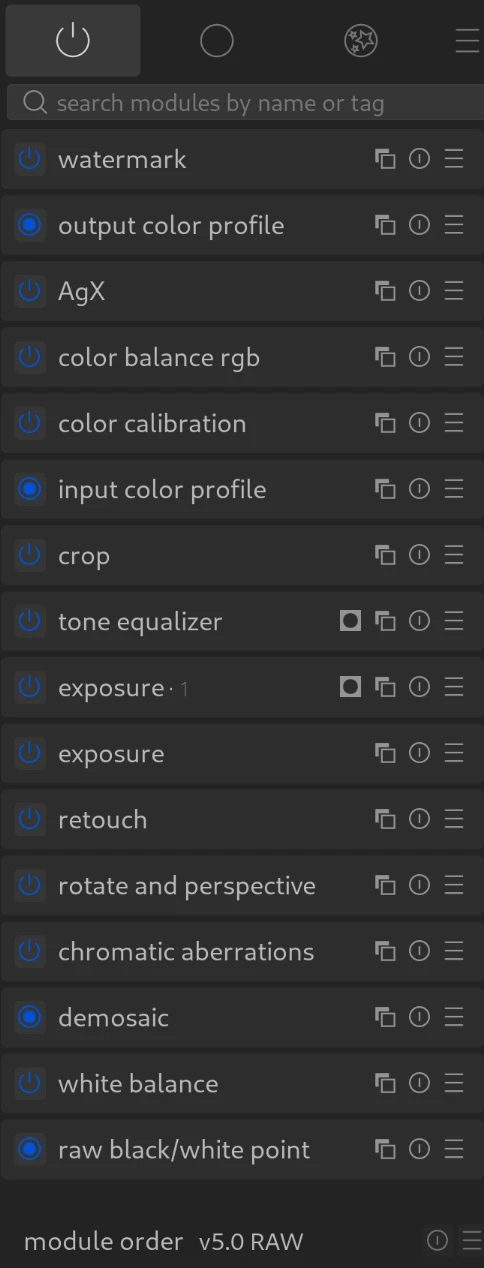
The pixel pipeline is the technically defined sequence in which Darktable calculates an image from RAW input to finished output.
- Direction: Processing runs strictly from bottom to top. The RAW image starts at the bottom of the module list, and each activated module adds a new processing layer on top of it.
- Visual representation: The order of the modules in the right-hand panel (darkroom) corresponds exactly to the order in which they are technically calculated.
Important: Processing Sequence vs. Result
The order in which you, as a user, apply the modules has no influence on the final result.
- It doesn’t matter whether you set the exposure first and then do the white balance (or vice versa).
- Darktable automatically sorts each step internally into the correct place in the pixel pipeline. You can jump to an earlier module at any time and change values; the entire pipeline is then simply recalculated with the new values. The history stack only shows when you did something, not how it is calculated.
Workflows (scene-referred vs. display-referred)
- Scene-referred (standard from v3.0):
Works with linear data and is physically correct. Important modules such as AgX are located very late in the pipeline. This minimizes artifacts and maximizes quality. - Display-referred (Legacy):
The old workflow, which operates non-linearly (similar to classic image editing). Modules such as the base curve intervene very early on here.
Changing the Order
- It is possible to move modules via
drag & drop. - However, this is strongly discouraged unless you know exactly what you are doing. The default order is optimized (e.g., demosaicing must come before the input profile). Changing it usually degrades image quality.